Showing posts with label how-to. Show all posts

Thursday, June 1, 2017

California Herps ID


Living in California is great for a lot of reasons, but one of them is that there are great taxonomy guides around.

The California Herps website is a fantastic resource you can use to ID and report your find, including information on lizards, snakes, turtles, frogs and salamanders. Here's how to use the site:

Determine if the animal you want to identify is a reptile or amphibian, then determine what type of reptile or amphibian you are attempting to identify - a snake, lizard, turtle, frog, or salamander, using the information and pictures below.

If the animal has hair or feathers or lacks a backbone, then it is not a herp and you should look elsewhere.

If the animal has smooth skin that looks wet, with no scales, then it is an Amphibian.
If the amphibian has four legs and a tail, it is a salamander.
if the amphibian has no tail, it is a frog
Toads are also amphibians - a type of frog - but their skin does not look wet. It is roughly textured, but there are no scales.
Newts also have rough skin at times. They can be differentiated from lizards by their lack of scales. 

If the animal is not a fish and it has scales, then it is a Reptile.
If the reptile has legs, but not a large shell on its back, it is a lizard.
If there are legs and a large shell on the back, it is a turtle.
If it has no legs and no shell, then it's a snake (or a legless lizard.) 

After you know the type of reptile or amphibian, click on the group name to view a page with pictures grouped by pattern or appearance or other characteristics. Read the brief descriptions and look for a picture of an animal that resembles yours, but beware that many types look similar. When you find the animal, click on the name to view more pictures, information, and a map showing where the animal occurs in California. The maps are general representations of where various animals occur in the state and they can quickly help you determine if an animal occurs in your area.

More info here.

Thursday, July 28, 2016

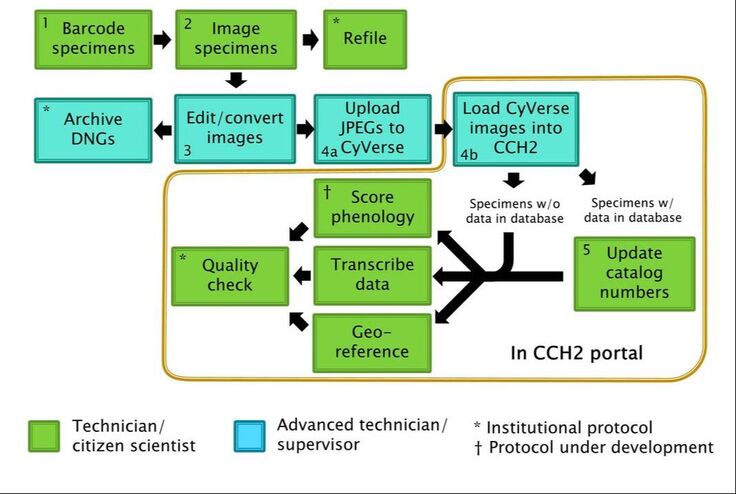
Herbarium Curation

Sagehen uses volunteers to manage its collections, including our herbarium. Here are some useful documents to help you understand the principles and strategy.
IMPORTANT! Be scrupulous about your field and lab notes. Keep a lab journal and field notebook. Document everything you do! Your effort is wasted--or even destructive--if you (and others) cannot later figure out what you did.
Organization and Management
https://www.capturingcaliforniasflowers.org/workflow--protocols.html

    * * * 

    Thanks to all our Sagehen Herbarium volunteers to date!
          • Erica Krimmel: program development; collections organization; digitizing; herbarium expansion; volunteer management.
          • Alex Gallandt: accessioning; mounting; collecting; updating taxonomy; reorganizing collection schema.
          • Angele Carroll: plant mounting; voucher filing
          • Hannah Johansson: accessioning assistance
          • All the California Naturalists and Weed Warriors who have helped at plant mounting days! 


    Saturday, September 5, 2015

    Field Guides


    Field guides are easy enough to find, but here are some harder-to-find tools you can use to develop your identification skills. I'll update this page from time to time if I find particularly good resources.

    Sunday, July 14, 2013

    Photo shooting tips; hand lenses.

    How to get the most out of your
    inexpensive digital camera.
    Today's digital cameras are capable of remarkable quality, but there are some tricks to getting the most out of them, especially when shooting close-ups of plants and insects.

    This download provides some help.

    * * *

    Brett Hall of the UC Santa Cruz Arboretum provided these tips for selecting a hand lens. These small lenses are invaluable in the field for quickly viewing tiny details of plant structures, insect bodies, mineral crystals, splinters in your fingers, etc.


    How to choose a handlens.

    Saturday, July 13, 2013

    iNaturalist assistance

    iNaturalist is a fantastic platform for developing your own citizen science projects. Here are some great tutorials about power-using it. Even if you already use iNat, you'll probably learn some useful things here.

    How to create an account...


    iNaturalist: Creating an Account & Changing Account Settings from S Cadwell on Vimeo.

    Adding a basic observation through the website, rather than with a smart-phone...


    iNaturalist.org: adding an observation from S Cadwell on Vimeo.

    * * *

    Got an account now? The following is a really rich and powerful video showing:
    • What is iNaturalist and who uses its data?
    • How to add an observation, 
    • How to batch observations, 
    • How to use iNaturalist as a field guide, 
    • How to incorporate your Facebook and other social media photos in iNaturalist,
    • How to invite other Facebook user photos to your project...


    Turning your Facebook photos into ctizen-science observations with iNaturalist from iNaturalist on Vimeo.
    * * *

    Once you are comfortable, you may want to learn how to set up your own project on iNaturalist...